Waiting
Analyzing image…
Advanced settings
SSIMSSIM Regret
Free browser-based vectorizer
Turn a WebP image into editable SVG paths without first converting it to PNG. VectorizeThis decodes the visible pixels locally, compares suitable traces, and lets you inspect the result.
PNG, JPG/JPEG, WebP, AVIF, or BMP · up to 100 images · 5 MB each
Preparing vectorizer…
Step 2
We’ll adapt tracing, scoring, cleanup, and SVG preparation automatically.
If the conversion process seems to stop or hang, keep at least one pixel of this browser tab visible on your screen so your browser does not background it and keeps the conversion process running.
With Chrome, having the converter as a background tab stops the conversion process. Having it as the main tab in a background window seems to keep the process going.
Analyzing image…
WebP is a raster format that may use lossy or lossless compression and can contain transparency. WebP-to-SVG vectorization rebuilds its visible color regions as paths; changing the extension alone would leave it as pixels.
WebP is used for logos, interface art, illustrations, and photographs. A lossless source with flat colors often gives clean boundaries. A lossy source may contain subtle edge changes that become extra SVG shapes, so compare color count and simplification when the result is busy.
A transparent WebP gives the tracer a clear outer boundary. If the file has an opaque background, VectorizeThis can offer background removal when it detects a sufficiently uniform connected region. Always inspect pale details near that boundary.
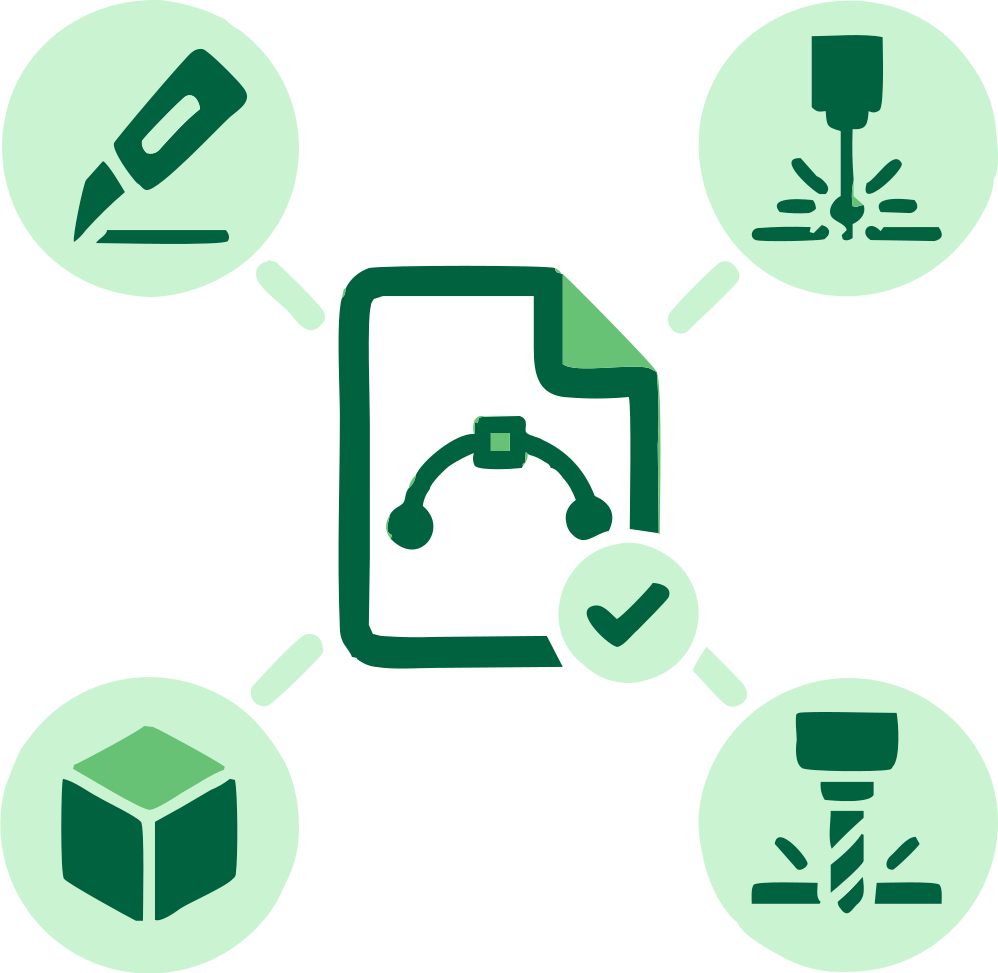
Use Logo or Web for flat graphics, Photo for continuous tone, and a fabrication use case only when the SVG is intended for that workflow. The selected use changes which candidate is preferred.
Select or drag up to 100 WebP files. Each file can be up to 5 MB and is processed in your browser.
Select Web, Logo, Photo, Cricut, laser cutting, or another use case. The choice changes which tracing candidates are tested and how the result is checked.
Compare the raster source with the traced SVG, adjust relevant settings, then copy the markup or download one file or the complete batch.
The result contains traced geometry instead of the original bitmap placed inside an SVG wrapper.
Conversion runs on your device; source images are not uploaded during vectorization.
VectorizeThis tests suitable tracing settings and keeps the strongest result it finds for each image.
When applicable, you can change the traced palette and rerun the result without starting over.
A uniform connected background can be detected and removed while you review the result.
Process several images, adjust them separately or in bulk, and download completed SVGs together.
Answers about real vector tracing, source quality, editing, and local browser processing.
Add an image above, choose its intended use, and wait while VectorizeThis compares suitable traces. Review the SVG before copying its code or downloading it.
Yes. You can use the converter and download the SVG without an account or payment.
Yes. The output contains SVG path geometry reconstructed from visible pixel regions; it does not simply embed the source image.
Transparent areas can remain outside the traced artwork. Semi-transparent edges are interpreted during tracing, so inspect soft shadows and antialiasing in the SVG preview.
No. VectorizeThis accepts WebP directly, so an intermediate PNG does not improve the source pixels.
Yes. Compression can add faint color changes around edges that a tracer may interpret as separate regions.
Logos, icons, line art, silhouettes, and flat illustrations with clear edges usually trace most cleanly. Texture, soft shadows, gradients, and noise require more paths.
The vectorization runs locally in your browser. An image is sent only if you explicitly attach it to a feedback form and submit that form.
Yes. You can recolor available swatches, copy the SVG markup, or open the downloaded paths in compatible vector software.
Recover scalable paths from WebP interface assets saved from a site.
Keep the outer silhouette separated while rebuilding visible color regions.
Create editable fills from a WebP copy when the original vector is unavailable.
Add your source image, choose the intended use, and compare the generated vector before downloading.
WebP to SVG Converter